Fixed Wireless Access (FWA) is evolving into a key enabler of broadband expansion in North America, augmenting wireline networks and helping close coverage gaps where wireline economics are challenging. What began as a targeted solution for underserved areas has matured into a core component of the North American broadband ecosystem, serving homes and businesses across urban, suburban, and rural environments. Today, most FWA deployments are delivered over 4G and 5G systems originally optimized for mobile eMBB users, with FWA effectively overlaid onto those designs. As the industry looks toward 6G, the focus is shifting from whether FWA has a role in standards discussions to whether next-generation air interface design will fully reflect real-world FWA deployment requirements.
That issue is exactly what the ATIS TOPS Council’s RAN Optimization for Fixed Wireless Access Group is addressing.
A North American Lens on a Global Standard
3GPP standards are built through global consensus, but deployment realities remain inherently regional. North American FWA differs materially from other markets, reflecting a larger geographic scale, distinct building characteristics, a unique spectrum mix, and widespread deployment into rural footprints that require tailored engineering approaches.
The ATIS RAN Optimization for FWA Group is focused on translating those regional characteristics into concrete technical inputs that can inform 3GPP evaluations and 6G design choices.
The group’s recent member contribution to 3GPP RAN1 provides a clear example of this translation in practice. It consolidates months of analysis into a clear set of observations and proposals to ensure FWA is accurately represented in the simulation assumptions that will shape 6G performance evaluation.
What this Expert Group is Saying
At a high level, the message to 3GPP is straightforward: FWA is not simply eMBB with a stationary user. The assumptions used to evaluate next-generation air interface technology must explicitly account for the distinct characteristics of FWA deployments.
A number of core themes underpin the group’s work.
First, FWA spans a broader range of deployment scenarios than any single channel model can fully capture. Suburban, rural, deep rural, and urban deployments each have their own cell sizes, base station heights, and CPE behaviors. The ATIS RAN Optimization for FWA Group has mapped these scenarios to the most appropriate channel model in 3GPP’s TR 38.901 to ensure simulations remain grounded in realistic conditions.
Second, spectrum strategy in North America is distinctively multi-band. While most FWA deployments today rely on FR1, operators are increasingly incorporating FR2 in parts of the rural footprint and expect to use new “FR3” mid-bands as they are defined. The group is advocating for evaluation assumptions that accurately reflect multi-carrier deployments, including configurations where higher-band carriers deliver capacity while lower-band carriers provide coverage.
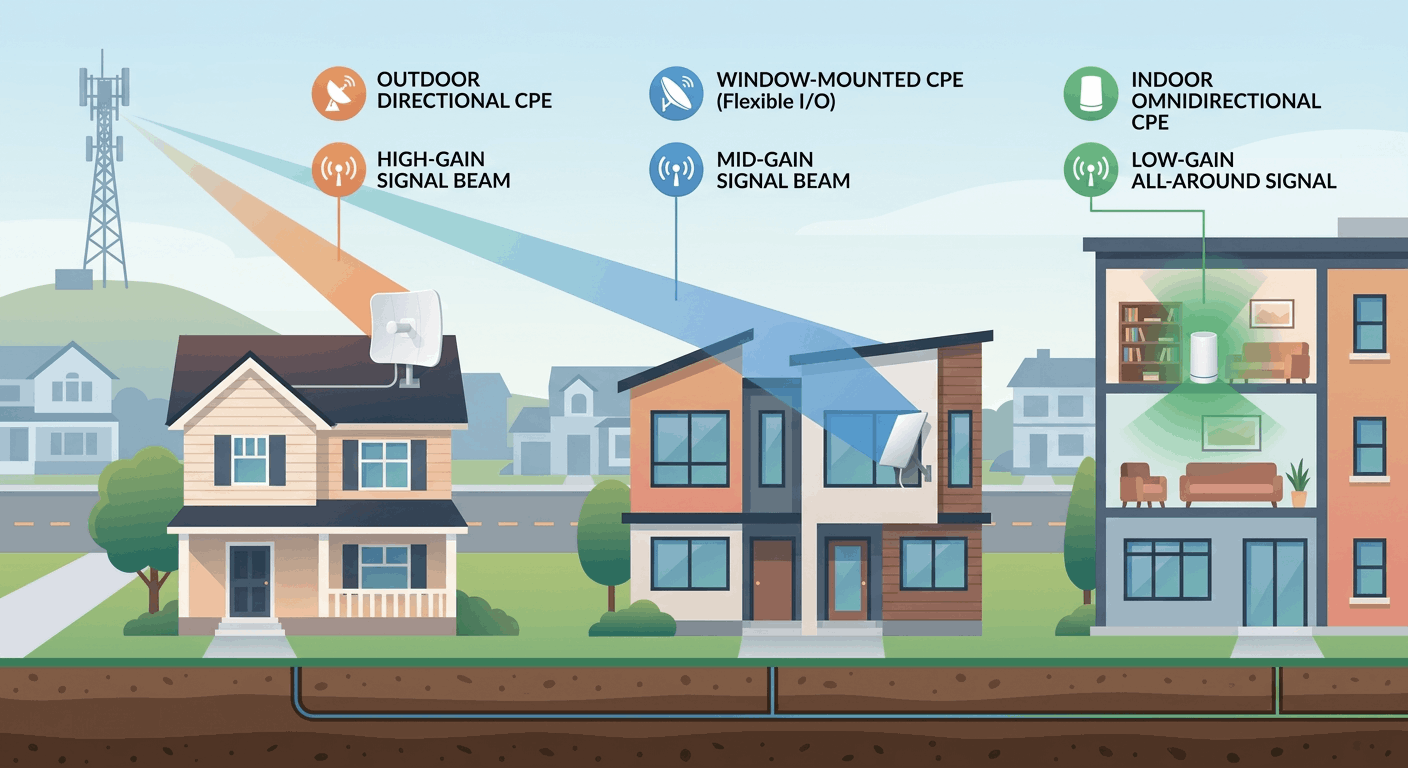
Third, CPE diversity materially impacts performance. Indoor, outdoor, and flexible indoor/outdoor CPEs are all in active use, with significantly different characteristics. Outdoor units typically are directional and aimed at the serving site; indoor units may be omnidirectional or directional, depending on design. Flexible units sit somewhere in between. The group has provided concrete recommendations on antenna heights, antenna patterns, and transmit power, highlighting that not all CPE operates at high power, and that handheld-class form factors should also be supported, particularly for indoor scenarios.
Fourth, realistic service delivery models must be reflected in evaluation frameworks. In practice, North American operators prequalify locations to ensure service meets defined performance thresholds. The group recommends incorporating this pre-qualification step into simulations, including mechanisms to exclude or reassign the lowest-performing locations to outdoor CPEs. This adjustment significantly improves alignment between simulated and deployed FWA performance.
Finally, FWA and eMBB increasingly share infrastructure. Whether through shared spectrum or dedicated carriers, networks must maintain distinct quality-of-service profiles across both services. This places greater emphasis on uplink performance, carrier aggregation, and support for high-power CPE classes as part of the standards toolkit.
Why This Matters Beyond the Standards Discussions
Decisions made in 3GPP simulation assumptions are easy to dismiss as plumbing, but they ripple outward. The parameters defined today shape which technology proposals demonstrate performance gains; which capabilities are prioritized for 6G; and ultimately, which solutions prove economically viable for operators and accessible for customers, particularly across diverse North American deployment environments. If FWA is modeled as an afterthought, a stationary handset, in effect, then 6G systems risk being optimized for conditions that do not reflect how FWA is actually deployed.
The work underway within the ATIS RAN Optimization for FWA Group is, in this context, both technically rigorous and strategically important. It ensures that the rural household connected via an outdoor CPE on a 7-kilometer cell, the suburban subscriber on a flexible indoor unit, and the urban enterprise customer sharing spectrum with mobile users are all explicitly represented in the assumptions that will shape the next generation of wireless system design.
Looking Forward
The group’s North American FWA scenarios are now under consideration within 3GPP RAN1, and key proposals spanning CPE power classes, antenna configurations, and indoor/outdoor pre-qualification criteria have been adopted into 6G performance evaluation criteria. Collectively, these inputs enable the development of 3GPP specifications that deliver the full potential of 6G in fixed wireless environments.
For those tracking how 6G will take shape in North America, this represents one of the more consequential and practical areas to watch. FWA performance in next-generation networks will depend in large part on whether the underlying design assumptions accurately reflect real-world deployment conditions. The ATIS TOPS RAN Optimization for FWA group is working to ensure those assumptions reflect how FWA is deployed in practice.
Learn more about the ATIS TOPS Council’s RAN Optimization for Fixed Wireless Access Group at https://atis.org/tops-council/ran-optimization-for-fixed-wireless-access/